
Verified numerical weapon stats for Hood Warfare 2 are not available in this guide. There is no checked table of damage, fire rate, range or aiming speed, so those fields cannot responsibly be filled with estimates. Weapon customization is confirmed, but the availability of attachments does not provide their numerical effects.
Identify the exact configuration first
Hood Warfare 2 supports sights, magazines, grips, suppressors and other attachments. A numerical comparison needs to identify which configuration it describes, rather than treating every version of a gun as the same entry.
Use the actual weapon view to identify the selected gun and its attachments. If the interface displays values, preserve their labels and units exactly. If it shows bars without numerical units, keep them as visual indicators rather than converting them into damage, milliseconds or percentages.
A screenshot of a weapon is useful for identifying the configuration. It does not measure the weapon's performance.
Keep different kinds of values separate
A menu value, an observed result and a calculated result answer different questions. Labeling them clearly makes a comparison easier to interpret.
| Value type | How to treat it |
|---|---|
| Numerical value displayed by the game | Preserve the label, unit and configuration shown |
| Unnumbered visual bar | Describe it as an interface indicator, without an invented scale |
| Measurement from an actual trial | Record the method and conditions alongside the result |
| Calculation based on measurements | Show which measured inputs it depends on |
| A value you cannot verify | Keep it unknown, not zero |
This table explains how to read data. It is not a claim that Hood Warfare 2 displays each of those value types.
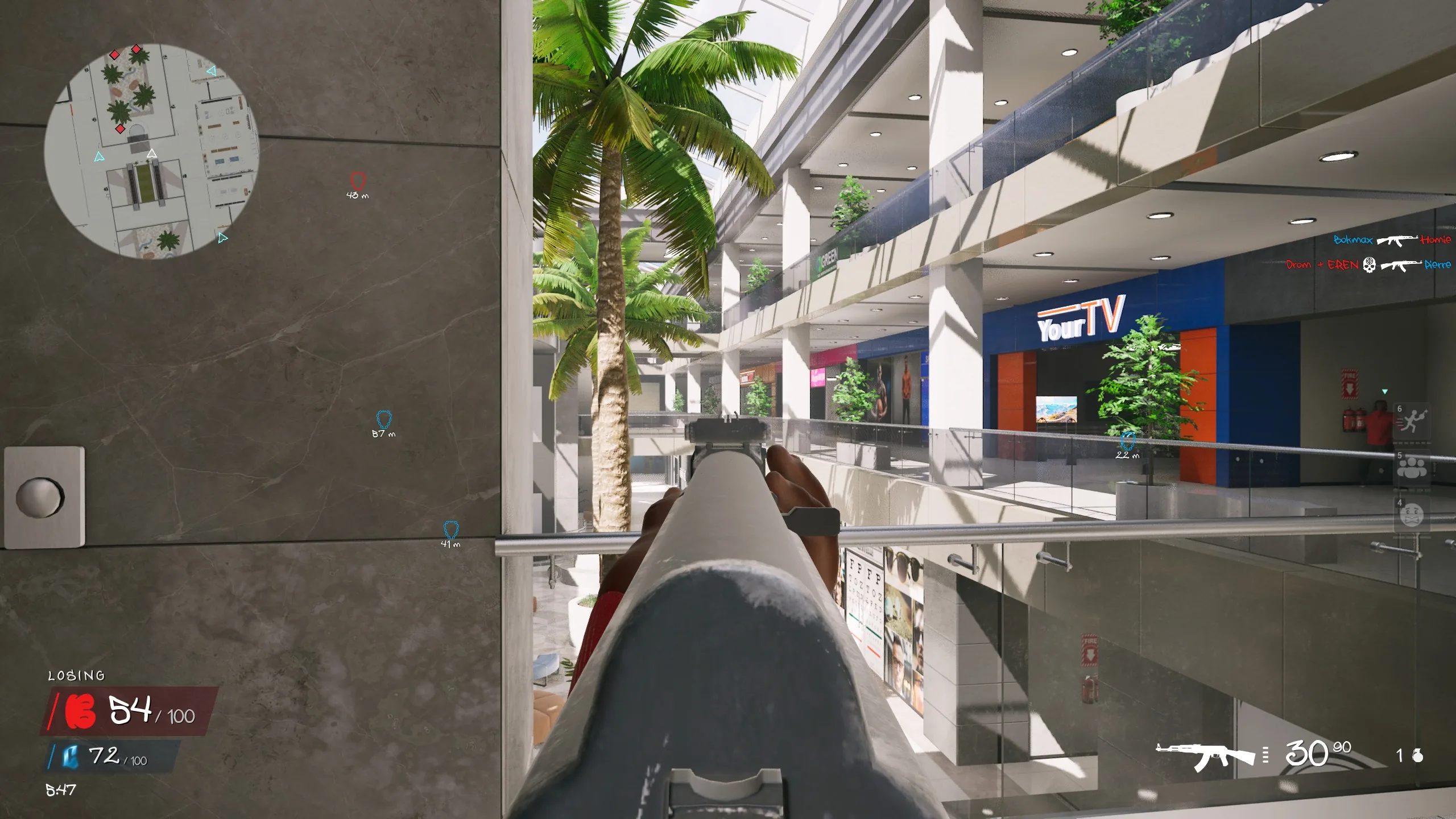
The ammunition readout is a current HUD value. It does not provide damage, fire rate or a measured time to kill.
Set up comparable observations
If you choose to investigate a property yourself, isolate that property. Keep the weapon and attachment configuration unchanged unless the attachment is what you are comparing. Write down the game version and the conditions you can actually control or observe.
For damage-related observations, distance and where a shot lands matter to the interpretation. Those conditions should be recorded rather than assuming that all shots are equivalent. This does not establish a particular damage multiplier or falloff rule in Hood Warfare 2.
For timing-related observations, define the start and end of the action before comparing clips. A fire-rate measurement and an aiming-transition measurement are different measurements, even though both involve time.
Repeat the observation where possible and keep uncertain outcomes out of the numerical result. This is a proposed measurement approach; no such trials have been completed for this guide.
Avoid unsupported strength calculations
Time to kill needs reliable inputs and stated assumptions. Without checked damage and timing data, a precise TTK would merely disguise unknown values as a number.
Likewise, a familiar gun model does not justify copying its stats from Call of Duty or another shooter. Compare only data for the actual Hood Warfare 2 configuration you are examining. Until those data are available, choose a weapon through direct use and keep numerical claims provisional.